The AI price war is becoming a world-economy story
America still holds a formidable capital advantage. China and a widening field of alternatives are challenging something more consequential: the assumption that advanced AI will remain scarce, expensive and controlled by a handful of firms.
The artificial-intelligence race is usually narrated as a contest to build the most intelligent machine. That is a real contest, but it may not be the one that decides the economic winners. The more consequential race is between two curves: the rising capability of AI systems and the falling price of using them. If capability spreads faster than scarcity, a model can lose some power to charge monopoly prices even as AI becomes more important to the economy. [1] That possibility is changing the meaning of competition. The United States remains the centre of private AI finance and a home for most of the best-funded labs. But China has shown that a challenger can make commercially useful systems without matching Silicon Valley’s funding model. Europe is betting that businesses and governments will pay for control over data and infrastructure. Elsewhere, countries are asking a larger question: will AI become a cheap input available to almost everyone, or a new utility whose most valuable layers are owned by a small group of foreign firms? A small but revealing signal arrived on 23 October. Reuters reported that a state-media-affiliated Chinese account said DeepSeek and MiniMax had received approval for global use of their AI models. The same week, Beijing had proposed controls on 23 AI-related technologies, including models, agents and computing clusters. China’s posture is therefore not simply “open models for the world”; it is a mix of export ambition, state oversight and strategic control. [5]
A capital advantage is not the same as a permanent lead
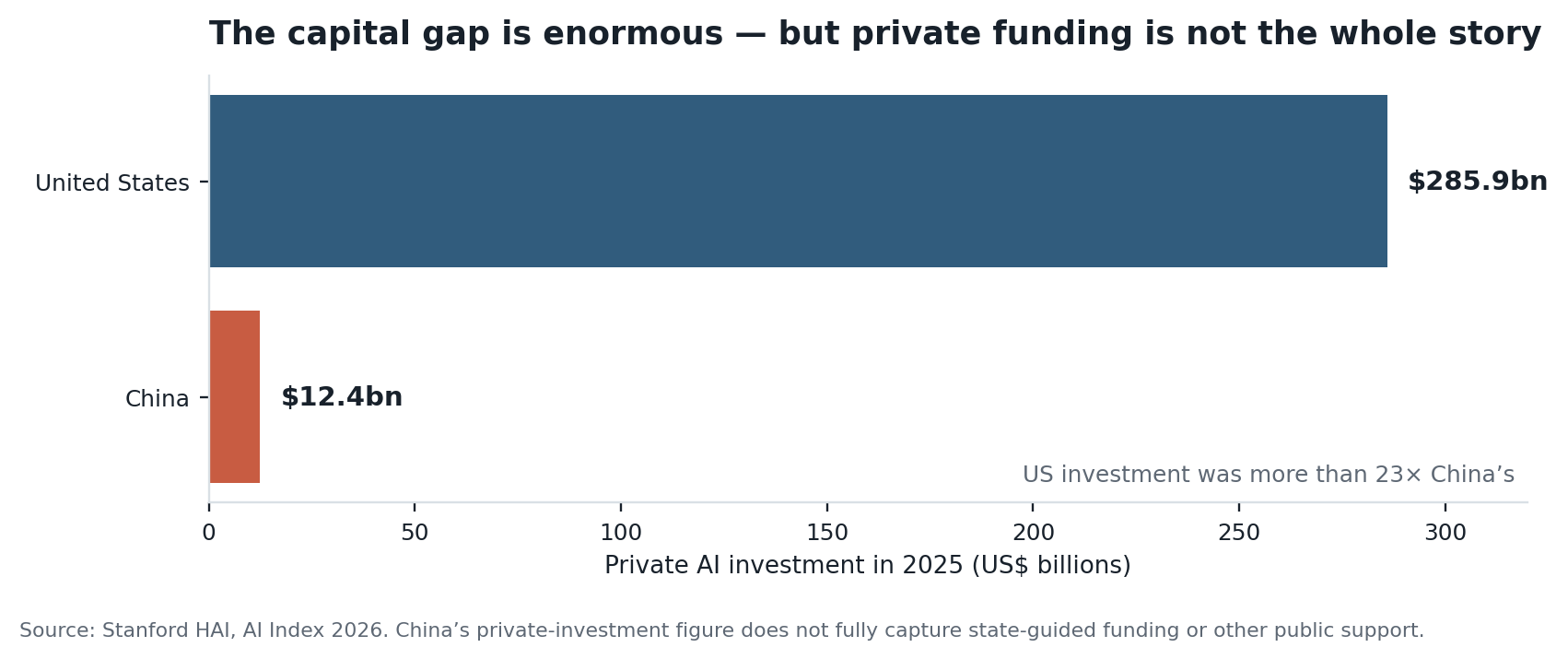
The financial imbalance is striking. Stanford’s 2026 AI Index put US private AI investment in 2025 at $285.9bn, more than 23 times China’s $12.4bn. That is a powerful advantage for recruiting researchers, buying scarce chips, building data centres and paying the enormous bills for frontier training. But it is a measure of private investment, not a complete tally of national spending. The report warns that China’s figure understates the role of government guidance funds and other state-directed support. [2]
Money still matters. Advanced chips, high-bandwidth memory, energy contracts and specialist talent are not cheap, and scale can create a feedback loop: more compute enables stronger models, which attract more users, which generate revenue and usage data to fund more compute. Yet capital intensity can coexist with a rapidly competitive model market. An advantage in building the largest system does not guarantee an advantage in every task, every price bracket or every country.
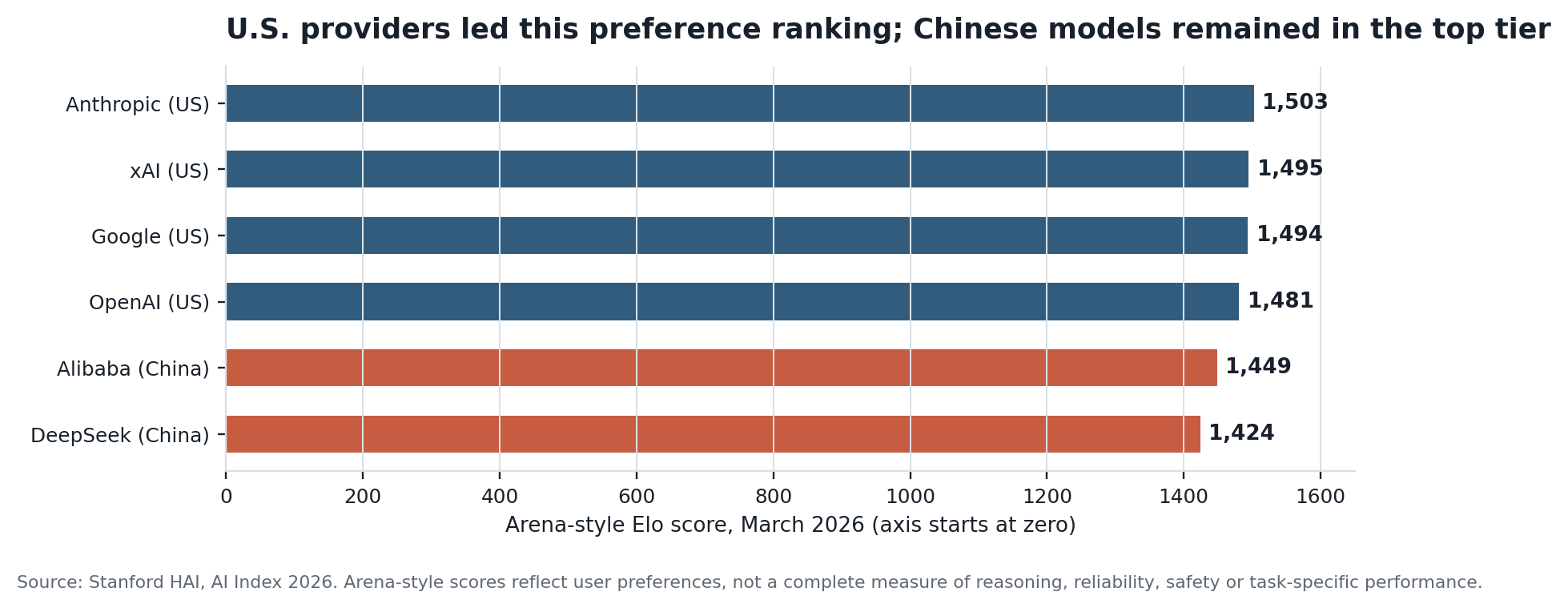
The evidence on model capability is more nuanced than either the triumphalist American story or the claim that the race is already even. Stanford’s March 2026 provider-level Arena-style scores placed Anthropic at 1,503, xAI at 1,495, Google at 1,494 and OpenAI at 1,481; China’s Alibaba scored 1,449 and DeepSeek 1,424. Stanford’s wider assessment describes the US-China model-performance gap as effectively closed, while still finding that the US produces more top-tier models. Such rankings reflect user preferences, not a universal measure of intelligence, reliability, safety or performance in every professional task. [2]
DeepSeek and Alibaba’s Qwen matter because they expand the set of capable alternatives. ByteDance’s Doubao adds the advantages of consumer distribution. MiniMax is another Chinese developer seeking international reach. In Europe, Mistral has a different opening: enterprises and public agencies that want locally governed systems, more control over deployment, or less dependence on American providers. These challengers do not need to beat OpenAI or Anthropic at everything. They need to be good enough, inexpensive enough, or better suited to a particular jurisdiction.
The more important curve is the price of intelligence
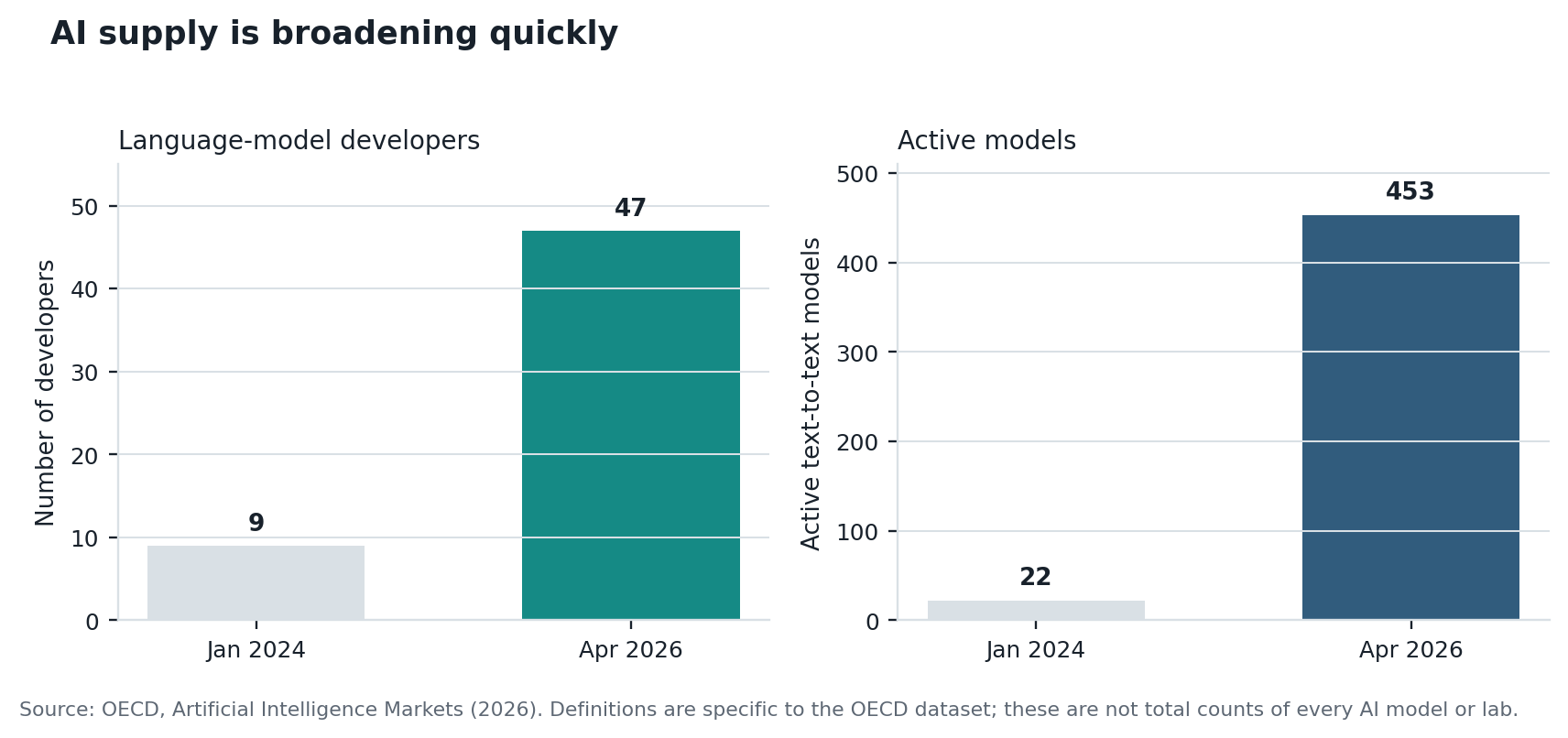
The number of serious alternatives has grown quickly. The OECD counted 9 developers focused on language models for cognitive tasks such as reasoning and coding in January 2024, compared with 47 in April 2026. The number of active text-to-text models in its dataset rose from 22 to 453 over the same period. The OECD also found that the number of developers reaching its performance-for-price “economic frontier” had risen from two to eight in three years. [1]
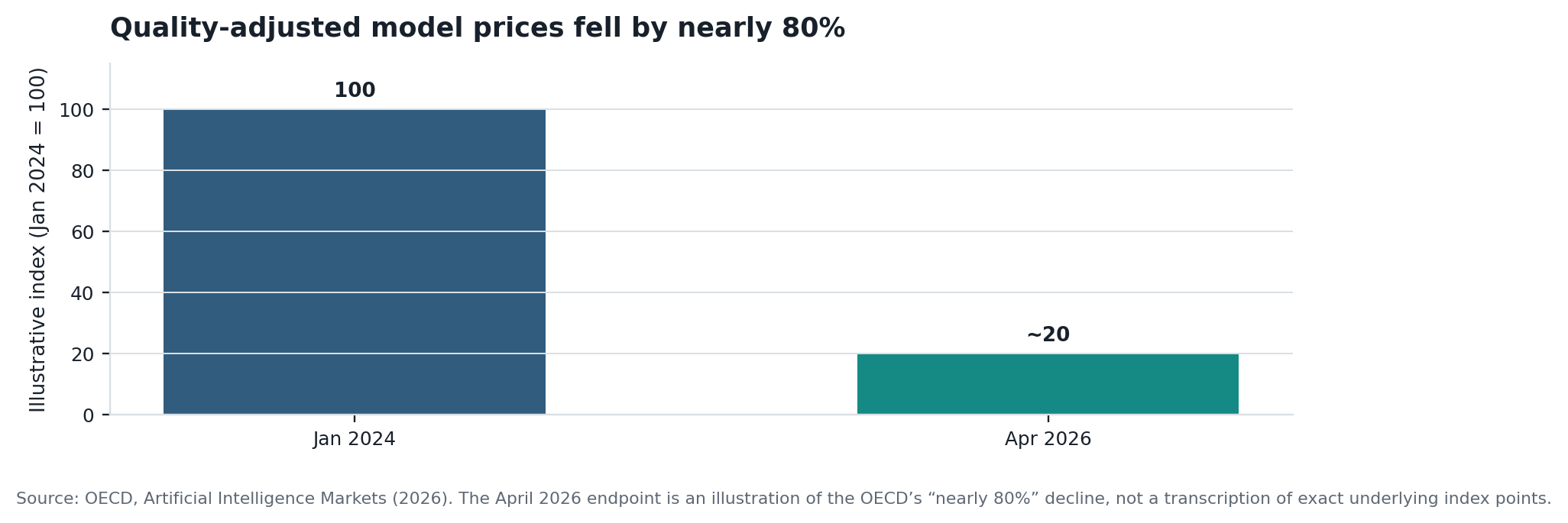
More consequential still, the OECD’s quality-adjusted price index for text models fell by nearly 80% between January 2024 and April 2026. In other words, buyers were getting more capability for less money. The price curve has not fallen smoothly, and top-end models can remain expensive, but the direction is clear: leadership at the performance-price frontier can last only a few months before another provider offers a better trade-off. [1]
This is good news for firms using AI, but not automatically for the firms selling it. If models become interchangeable, buyers can route routine requests to a cheaper provider, run open-weight models on their own infrastructure, or demand discounts from proprietary vendors. Open models also let local companies adapt systems to their languages, regulations and data without paying for every inference through a foreign API.
Yet a low price per token is not the same as a low cost per task. Agents that plan, call tools, retry and verify can consume many more tokens than a simple chat response. The OECD cautions that greater agent use can raise total expenditure even while unit prices fall. What matters is whether AI reliably completes valuable work, not just whether its tokens are cheap. [1]
The scarce thing may no longer be access to a capable model. It may be reliable work, trusted deployment and the infrastructure that lets a model run at scale.
The business model is shifting from answers to outcomes
OpenAI and Anthropic illustrate the transition. OpenAI has a broad consumer audience as well as developer APIs, business subscriptions and agent products. Anthropic has become especially strong in enterprise and coding usage. Their financial headlines are eye-catching, but they also show how hard it is to compare private AI companies with precision.
Reuters reported that OpenAI’s September 2026 annualized revenue run rate was nearly $50bn, below an earlier figure of about $70bn that had circulated. The discrepancy was attributed largely to attempts to make the company’s figures comparable with Anthropic’s: OpenAI excludes certain revenue generated through cloud partners, while Anthropic includes it differently. A run rate extrapolates a recent revenue pace; it is not a full year of audited sales. [3]
Anthropic, meanwhile, told prospective investors that quarterly revenue reached $16.8bn in the third quarter of 2026, up from $11.6bn in the second quarter and $4.7bn in the first. Sequential growth slowed to 45% in the third quarter after more than doubling in the second. That is still rapid expansion, but it illustrates the arithmetic of a business that cannot compound at the same extraordinary rate forever. [4, 13]
Valuations are moving just as quickly. On 23 October, the Financial Times reported that OpenAI had lowered its target valuation for a proposed funding round to $1.25tn from $1.4tn, with the financing not yet complete. Anthropic’s prospective public-market valuation was also being reconsidered after new financial disclosures. These are reported financing expectations, not settled market prices; their volatility is itself a reminder that forecasts about future AI rents remain uncertain. [12, 4]
The cost base is unusually demanding. Reuters reported that Anthropic’s draft prospectus showed nearly $9bn in computing-capacity and infrastructure spending in the first half of 2026, compared with $2.3bn a year earlier. Its reported $80.7bn first-half net loss included a $72bn non-cash accounting charge tied to the estimated value of convertible bonds; that number should not be mistaken for an equivalent cash operating loss. The same report said the company had committed to at least $518bn in cloud, compute and infrastructure spending over a decade. [4]
The lesson is not that the industry is doomed, nor that every valuation is justified. It is that the AI economy resembles a capital-intensive utility business grafted onto fast-changing software. Revenue can surge while infrastructure commitments grow faster; model prices can fall while the total volume of computation rises. Sustainable profits will depend on who captures value in the layers around the model: distribution, enterprise integration, workflow ownership, security, specialised tools and the ability to deliver useful outcomes at predictable cost.
Productivity could rise before employment falls — and inequality may widen anyway
The social stakes are larger than the fortunes of the model labs. A January 2026 study using data from more than 12,000 non-financial firms in Europe and the United States found that AI adoption increased the level of labour productivity by about 4% in European firms in its analysis. The authors attributed the gain to capital deepening and found no adverse firm-level employment effect in the short run. But the gains were uneven: they were concentrated in medium and large firms, which were also better placed to make complementary investments in software, data and training. This is early firm-level evidence, not a promise of a 4% boost to every economy. [8]
The ILO’s 2025 global assessment estimated that one in four workers worldwide is in an occupation with some degree of exposure to generative AI. Its central finding was that transformation is more likely than wholesale replacement for most jobs, because human input remains necessary across many occupations. Exposure, however, is not the same as a benign outcome. If employers use AI to intensify work, weaken bargaining power or reduce entry-level hiring, jobs can change for the worse even when they do not disappear. [7]
The distribution of gains will depend on who owns the complementary assets. A large company with proprietary data, modern software and engineers can turn a capable model into a productivity system; a small business may get a chatbot but lack the time to redesign its operations. Workers who learn to supervise and integrate AI may become more valuable, while routine drafting, support and analysis tasks face pressure. Education systems, vocational training and labour institutions will influence whether productivity gains become higher wages, lower prices, larger profits or some mixture of the three.
For consumers, cheaper AI could be a broad welfare gain: tutoring, translation, coding assistance and professional services may become accessible to people who could not previously afford them. For public services, it could help overstretched schools, clinics and administrations. But those benefits will not distribute themselves. The World Bank warns that high-income countries dominate AI innovation, compute infrastructure and startup funding, while adoption remains limited in low-income economies because connectivity, compute, locally relevant data and digital skills are unevenly available. [9]
There is an uncomfortable possibility that AI narrows one digital divide while widening another. A low-cost model can make world-class language and coding assistance available almost anywhere with an internet connection. Yet countries without reliable power, skilled workers, local-language data or bargaining leverage may remain consumers of systems whose profits, data flows and strategic decisions sit elsewhere. Open-weight models can help countries adapt technology locally, but they do not by themselves provide chips, infrastructure, security expertise or institutional capacity.
The cloud is weightless only from a distance
The economics of AI are often discussed as if software were frictionless. In practice, the models run on chips, inside data centres, connected to power grids, cooled with water or air and supplied through highly concentrated hardware chains. The International Energy Agency projects that global data-centre electricity consumption will rise from 485 terawatt-hours in 2025 to 950 TWh in 2030, around 3% of global electricity demand. Electricity use by AI-focused data centres is projected to triple over the same period. [6]
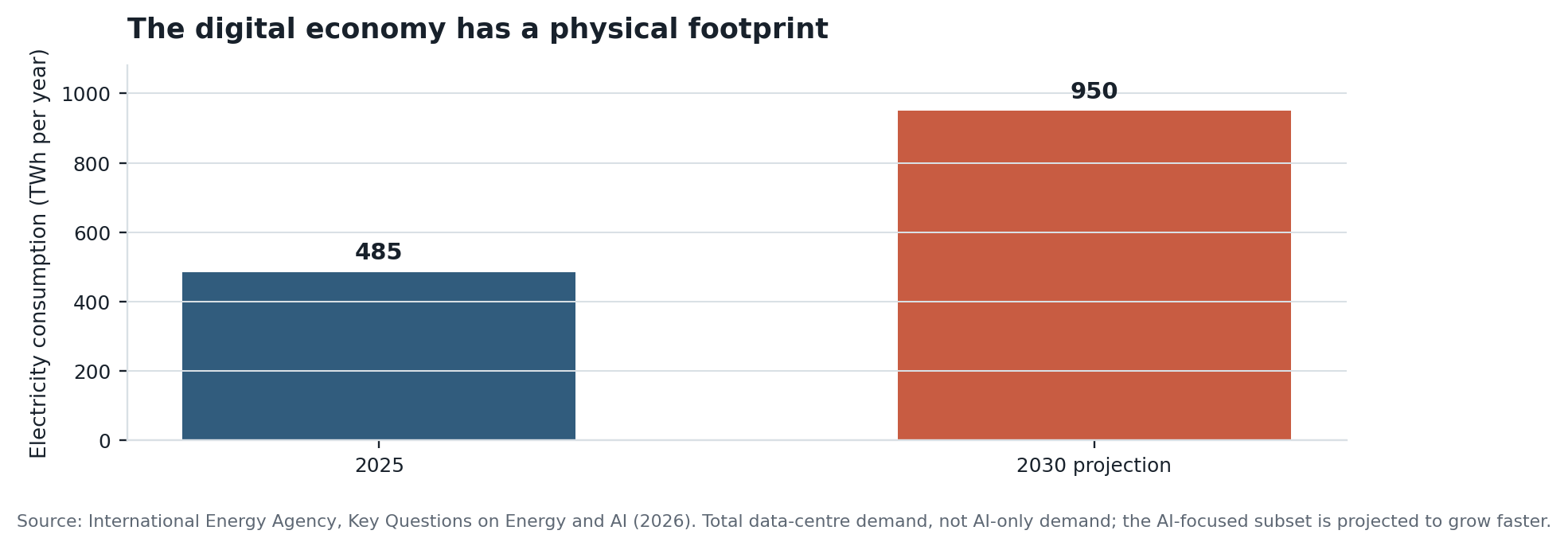
The physical constraints matter to competition. The IEA points to bottlenecks in energy equipment, grid connections and advanced-chip supply chains, including a shortage of high-bandwidth memory expected to persist through at least the end of 2027. Stanford notes that the United States has the largest number of data centres, while a single Taiwanese foundry remains critical to production of leading AI chips. The model market can become more competitive even as the infrastructure market remains concentrated. [6, 2]
This creates a policy paradox. Governments want cheaper, more widely available AI, but they also want domestic capacity, secure supply chains and energy resilience. Subsidising every country’s own frontier model may be wasteful; relying entirely on a handful of foreign cloud providers may be risky. The practical middle ground may include shared research infrastructure, public procurement that supports interoperability, regional compute facilities, model choice and investment in grids and skills rather than prestige projects alone.
Europe’s approach also shows the limits of regulation as industrial policy. The EU AI Act’s main application milestones began in August 2026, while some high-risk system obligations have been phased to later dates. Rules can build trust and give customers clearer responsibilities, but compliance costs may weigh more heavily on smaller providers than on the largest global platforms. European sovereignty will require more than rule-making: it needs customers, capital, distribution and compute. [11]
What should governments and businesses do?
First, treat model competition and infrastructure competition separately. More model providers and open weights can reduce rents at the application layer; concentration in chips, cloud platforms and power can preserve bottlenecks elsewhere. Competition authorities should look for lock-in and exclusionary contracts, but they should also avoid assuming that every large investment is anti-competitive simply because it is large. Training a frontier model has real fixed costs.
Second, measure outcomes rather than model announcements. Businesses should ask whether an AI system reduces cycle time, error rates or total cost of serving a customer. Governments should publish comparable data on adoption, productivity, wages, compute, energy and concentration. A falling API price is valuable, but its social value depends on whether it produces better services and broad-based gains.
Third, invest in the complements: workers’ skills, local data, digital infrastructure, cybersecurity and reliable electricity. The World Bank’s “four Cs” — connectivity, compute, context and competency — are an unglamorous but useful starting point. [9] Fourth, make room for multiple providers. Portability, open standards and clear data rights reduce the risk that a single vendor can capture the value of workflows built around its models.
Finally, do not confuse lower model prices with the end of risk. More capable and more accessible models can improve science and public services, but they can also magnify fraud, cyber abuse, misinformation and surveillance. The answer is neither to close every model nor to assume that openness is always safe. It is to make deployment-specific risk controls, accountability and security part of the market’s operating costs, while allowing legitimate competition to proceed.
The contest is about who benefits from abundance
The United States still has a formidable lead in private AI investment and hosts much of the frontier ecosystem. China’s challenge is real, but it is not a single company marching towards a single benchmark. It is a network of developers, open models, consumer platforms and state-backed ambitions that can compete on price, distribution and local fit. Europe and other regions may succeed in narrower markets where sovereignty, language or regulation matters more than the very largest model.
The biggest threat to OpenAI and Anthropic may therefore be less dramatic than a rival unveiling a system that is unmistakably smarter. It may be a world in which good-enough models become cheap and interchangeable, forcing expensive frontier labs to justify their premiums while cloud and chip suppliers capture a disproportionate share of the returns. That could be an excellent outcome for customers — if competition reaches the infrastructure layer too.
For society, the stakes are not simply whether America or China wins. They are whether the decline in the cost of intelligence becomes a rise in shared productive capacity, or merely a new source of concentrated rents. Cheap AI could make expertise more accessible, help firms become more efficient and create new services. It could also leave workers absorbing the disruption, taxpayers underwriting infrastructure and poorer countries dependent on technology they cannot shape. Those outcomes are not predetermined by the models. They will be decided by the institutions, markets and investments built around them.
Sources and further reading
- OECD, “Artificial Intelligence Markets” (2026). Market structure, model and developer counts, quality-adjusted price decline, and competitive dynamics.
- Stanford HAI, “The 2026 AI Index Report” (2026). Private AI investment, model-preference scores, global adoption, and concentration of infrastructure.
- Reuters, “OpenAI’s September annualized revenue nears $50 billion, less than previously indicated” (8 October 2026). Reported OpenAI run rate and caveats about revenue treatment through cloud partners.
- Reuters, “Anthropic logged net loss of over $80 billion in first half of 2026” (20 October 2026). Reported Q1–Q3 revenue figures, infrastructure spending and large non-cash accounting charge.
- Reuters via Investing.com, “China’s DeepSeek, MiniMax win approval for AI global use, state media-affiliated entity says” (23 October 2026). Reported approval claim and context of proposed Chinese AI technology export controls.
- International Energy Agency, “Key Questions on Energy and AI” (2026). Data-centre electricity projection and supply-chain constraints.
- International Labour Organization, “Generative AI and jobs: A 2025 update” (20 May 2025). Global exposure estimate and the distinction between job transformation and job replacement.
- Aldasoro et al., CEPR Discussion Paper 21082, “AI Adoption, Productivity and Employment: Evidence from European Firms” (25 January 2026). Firm-level productivity evidence and distribution of adoption gains.
- World Bank, “Digital Progress and Trends Report 2025: Strengthening AI Foundations” (2025). Global gaps in AI innovation, compute, connectivity, data and skills.
- UN Trade and Development, “Technology and Innovation Report 2025: Inclusive artificial intelligence for development” (2025). Concentration in AI research, infrastructure and risks to inclusive development.
- European Parliament Research Service, “AI Act – Implementation timeline” (updated 21 October 2026). EU AI Act implementation calendar as updated in 2026.
- Financial Times, “OpenAI trims valuation target to $1.25tn after pitching higher price” (23 October 2026). Reported proposed funding-round valuation target; round not completed at the research cutoff.
- Reuters Breakingviews, “Anthropic’s $2 trln dream faces deflation trap” (15 October 2026). Analysis of falling token prices, usage growth, revenue growth and profit-margin questions.
See also: Competitiveness Definition in Economics, What is the Capital Market?, Economic Growth and Development, Economic Model.