Types of Elasticity of Demand

- Perfectly Elastic: EP → -∞
- Relatively Elastic: -∞ < EP < -1
- Unit Elasticity: : EP = -1
- Relatively Inelastic: -1 < EP < 0
- Perfect Inelastic: EP = 0
- Price Elasticity of Demand
- Cross Elasticity of Demand (the elasticity in relation to the change of the price of other good and services)
- Income Elasticity of Demand
- Advertisement Elasticity of Demand (the elasticity in relation to the advertisement expenditure)
- Perfectly Elastic
- Relatively Elastic
- Unit Elasticity
- Relatively Inelastic
- Perfect Inelastic
Price Elasticity of Demand
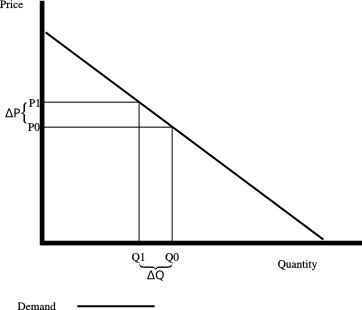 The price elasticity of demand is the proportional change in the quantity demanded, relative to the proportional change in the price of the good.
Price elasticity of demand = Percentage change in quantity demanded / percentage change in price = ΔQ/Q / ΔP/P
Cross Elasticity of Demand
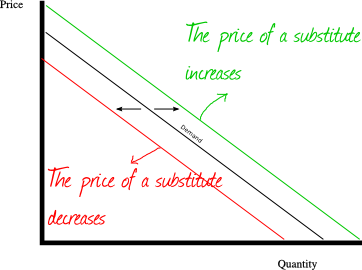 The cross elasticity of demand is the proportional change in the quantity demanded, relative to the proportional change in the price of another good.
Price elasticity of demand = Percentaje change in quantity demanded / percentaje change in price of another good = ΔQ1/Q1 / ΔP2/P2
Looking at the chart, the change in the price of another good shifts the demand curve to the left or to the right.
If the two goods are substitutes, the cross elasticity of demand is positive.
If the two goods are complements, the cross elasticity of demand is negative.
Income Elasticity of Demand
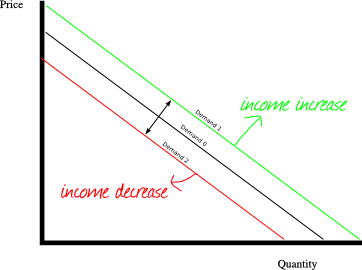 The income elasticity of demand is the proportional change in the quantity demanded, relative to the proportional change in the income.
Income elasticity of demand = Percentaje change in quantity demanded / percentaje change in the income = ΔQ/Q / ΔI/I
Advertisement Elasticity of Demand
 The advertisement elasticity of demand is the proportional change in the quantity demanded, relative to the proportional change in the price of another good.
Advertisement elasticity of demand = Percentaje change in quantity demanded / percentaje change in expenditure in advertising = ΔQ1/Q1 / ΔAd2/Ad2
The quantity demanded increases when the advertising expenses increase. The advertisement elasticity is positive.
According to the value of the elasticity
Up to here, we have pointed out different types of elasticity according to the function we are analyzing, and according to the inputs we are considering. Now we will see how the supply and the demand can be classified according to the value of the elasticity.Perfectly Elastic Demand: EP → -∞
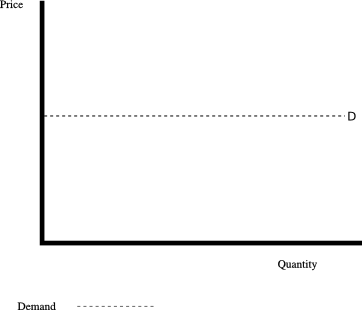 Perfect Elastic Demand: The elasticity tends towards -∞.
When the demand is perfect elastic, it drops to zero in the face of a minimal price increase. If the price is the same of below the point where the demand touches the vertical axis, the market will demand all the quantity offered.
Relatively Elastic Demand: -∞ < EP < -1, unit elasticity demand and relatively inelastic demand
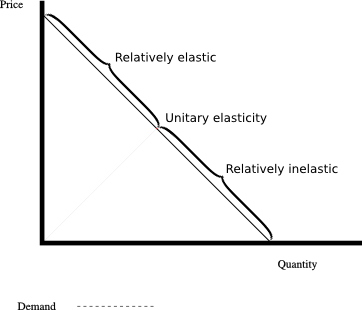
Relatively elastic demand: The elasticity is between -1 and -∞.
Unit Elasticity Demand: EP = -1 , the elasticity is -1.
Relatively Inelastic Demand: -1 < EP < 0 , the elasticity is between 0 and -1.
Perfect inelastic demand: EP = 0
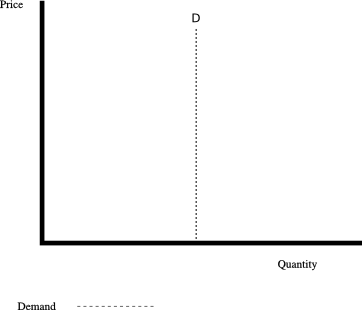 A perfect inelastic demand has an elasticity of 0. The quantity demanded will not change despite changes in the price.