Business strategy: choices, resources, and results
Business strategy is a firm's coordinated approach to competing in its chosen markets.[1] It connects choices about customers and activities with the resources needed to carry them out.
What business strategy is
A strategy explains how a firm intends to address a competitive challenge. Related concepts serve different purposes:
- Goal. A desired result, such as higher profitability.
- Mission. The organization's purpose.
- Implementation plan. Assigned tasks, budgets, and deadlines.
These can support a strategy, but each answers a different question. Richard Rumelt's 2011 account places diagnosis, an overall approach, and coordinated action at the center of strategy.[1]
Consider a hypothetical distributor seeking more dependable sales. Its goal might be to retain customers. Its strategy might be to serve repair businesses that value reliable delivery, concentrating its inventory and delivery capacity on their needs. The associated plan would specify which products to stock, who manages replenishment, and when delivery capacity becomes available. The strategy supplies the reason for those allocations.
Michael Porter's 1996 account distinguishes competitive positioning from improvements in the performance of existing operations.[2] In the distributor example, more accurate picking improves operations; choosing which customers and delivery promises to organize around establishes the competitive approach. Management must examine both the usefulness of its offer and its ability to provide it.
Customers, competitors, and economic constraints
Diagnosis begins with the customer's alternatives. A firm needs to identify what buyers value, what they can substitute, and the conditions under which they would switch. Porter's industry analysis, published in 1980, examines rivalry among existing firms alongside entry, substitutes, and the bargaining power of buyers and suppliers. Each can constrain the returns available to a business.[3]
For the hypothetical distributor, the relevant alternative might be a competing supplier, direct purchasing from a manufacturer, or a customer holding more stock. A delivery promise has value only in relation to those alternatives and the customer's cost of waiting. A powerful supplier could also change the economics by raising input prices or restricting availability. These are questions to investigate, rather than assumptions to bury inside a sales forecast.
The diagnosis must also examine what the firm can provide. Jay Barney's 1991 resource-based account starts from differences between firms' resources and the difficulty of transferring or reproducing them.[4] For the distributor, the assessment would include warehouse capacity, product knowledge, supplier relationships, and working capital. A proposal to hold more inventory needs financing as well as evidence of demand. If financing is the binding constraint, a strategy built around an unaffordable stock commitment cannot be evaluated solely by its customer appeal.
Strategic choices and trade-offs
Porter's Competitive Advantage, originally published in 1985, describes cost advantage and differentiation across different competitive scopes. A cost advantage concerns the cost of providing an offer; it does not require charging the lowest price. Differentiation gives buyers a reason to prefer the offer. A focused strategy selects a narrower segment and can pursue either route within it.[5]
These categories help specify the intended source of returns. For the distributor, differentiation might rest on dependable availability for selected repair needs. A cost-oriented alternative might simplify the range and standardize deliveries. The assessment would compare the customers served, resources required, and revenue needed to cover each system's costs.
Choosing the delivery promise also sets priorities. If the hypothetical business promises urgent delivery on every product while funding only a limited stock range, its commitments conflict. It would need to narrow the promise, obtain additional capacity, or change its supply arrangements. Rumelt identifies reluctance to choose as a weakness in strategy.[1]
Trade-offs do not imply that every improvement requires deterioration elsewhere. Removing an avoidable picking error could improve service and reduce rework together. The strategic question is whether the chosen combination of commitments is feasible, including the activities on which each commitment depends.[6]
Resources and coordinated activities
A resource can help a firm without providing a durable advantage. Barney's account asks whether it is valuable, rare, difficult to imitate, and difficult to replace with an equivalent. Widely available equipment may improve production while leaving competitors able to make the same improvement. Durability depends partly on what rivals can reproduce or achieve by another means.[4]
Coordination adds another condition. In their 1995 analysis of manufacturing, Paul Milgrom and John Roberts describe complementarities: the return to one choice can increase when another choice is made. Investment, work organization, and information systems can therefore need joint assessment. Combining selected features of different production systems can produce an ineffective whole.[6]
Suppose the hypothetical distributor installs inventory software. Training employees to record stock movements and assigning responsibility for correcting discrepancies could make the software more useful. If stock records remain inaccurate, additional software features would have little relevance to a delivery promise based on product availability. This example illustrates a possible complementarity; the firm would still need evidence that these particular changes improve its service.
The investment case should therefore identify dependencies. A warehouse expansion proposal should state which demand estimate supports it, which staffing arrangements it assumes, and what it requires from suppliers. Assessing the package helps management avoid funding capacity whose necessary supporting activities remain unresolved.
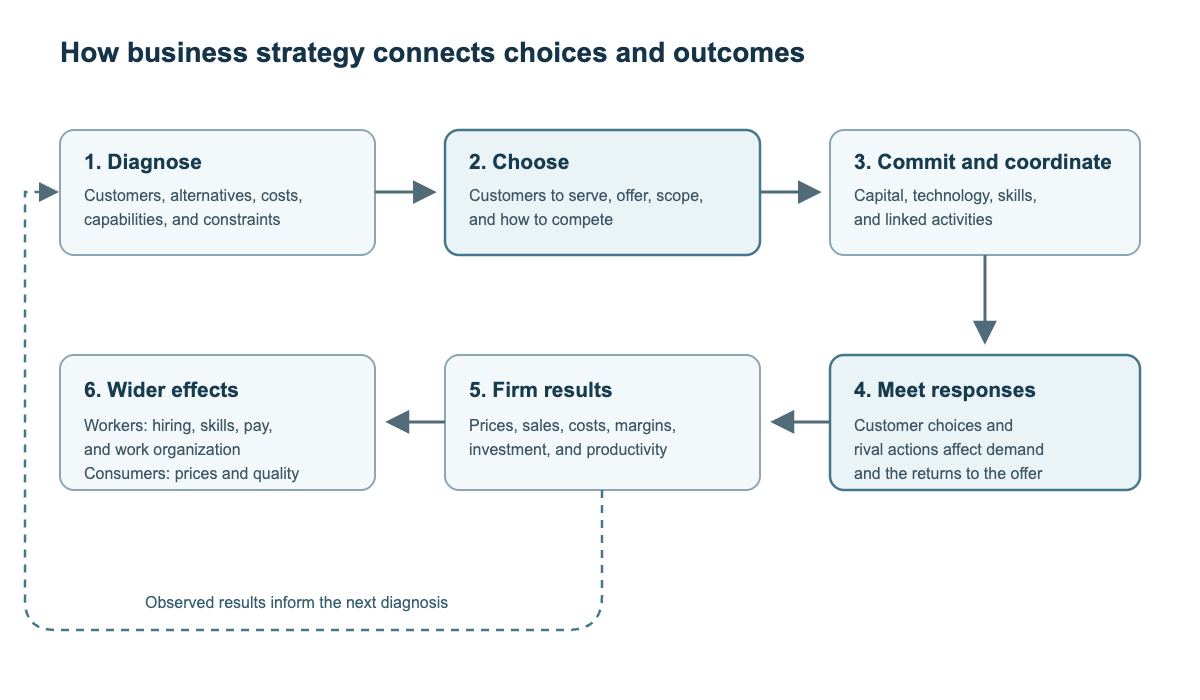
How business strategy is built and tested
Rumelt's framework supplies a starting structure: identify the central challenge, choose an approach, and organize actions around it.[1] Management can make that structure assessable through a practical progression:
- Record the assumptions. For the hypothetical distributor, the central assumption might be that repair businesses will purchase more consistently in exchange for dependable availability.
- Allocate resources and responsibility. Specify the resources committed to the choice and assign responsibility for carrying it out.
- Run a limited trial. Track repeat orders, delivery performance, stock shortages, and the cost of keeping the promise.
- Assess customer response and resource use. Increased sales alone would leave the economics unresolved if additional stock and delivery costs absorbed the revenue. The test needs measures of both.
- Define grounds for revision. Identify the observations that would support changing the approach.
The strategic planning process provides a detailed framework for scheduling implementation, monitoring results, and revising plans. Learning also extends beyond formal reviews. Henry Mintzberg and James Waters's 1985 distinction between deliberate and emergent strategy allows realized patterns of action to differ from initial intentions.[7] A trial can reveal a useful customer segment that the original proposal overlooked.
Implementation has measurable operational consequences in some settings. A randomized experiment involving 17 volunteer Indian textile firms compared diagnostic consulting with diagnosis plus implementation assistance. Performance records covered April 2008-August 2010. The final study, published in February 2013, reported the estimates below.[8]
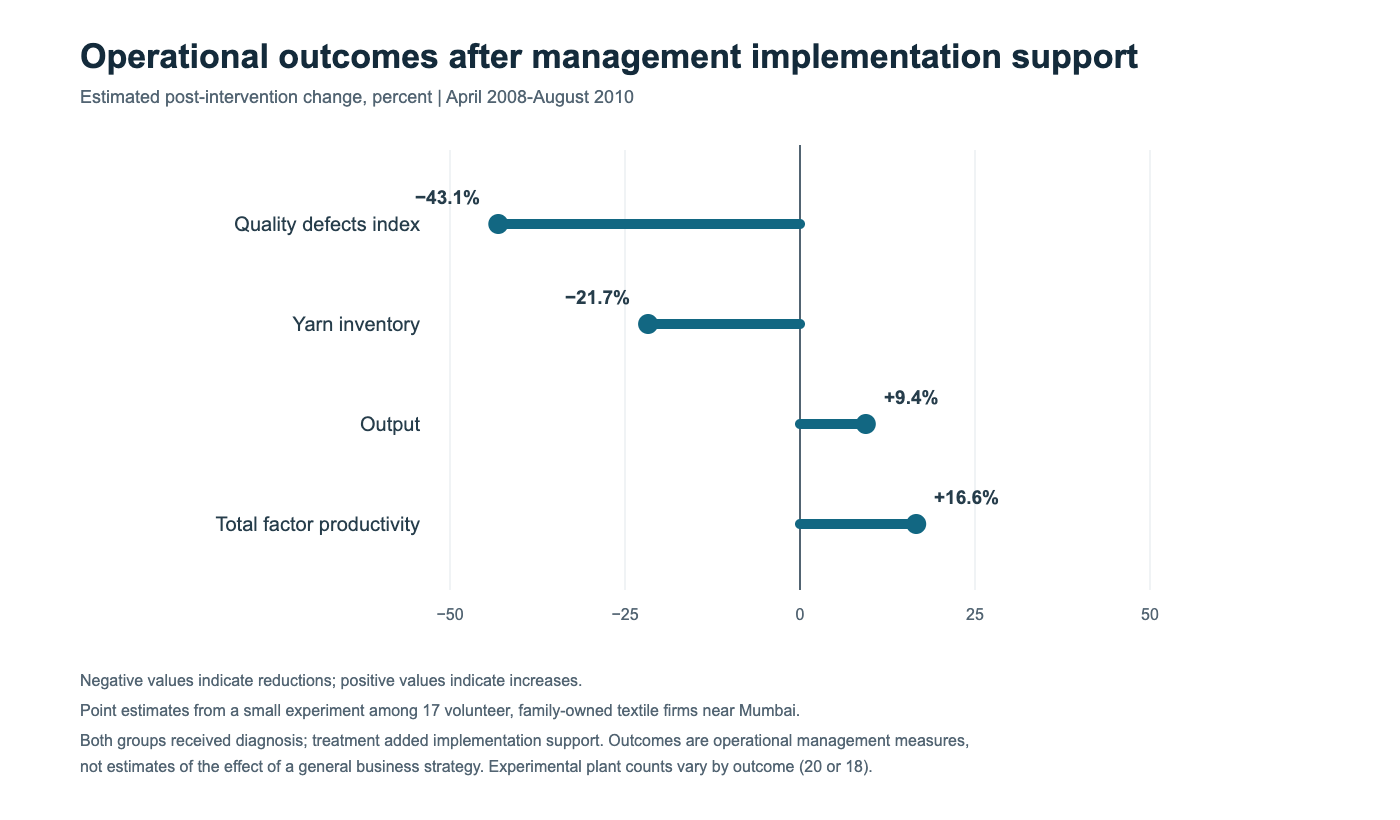
The defects measure is a weighted index, and output measures weaving production rather than sales revenue. Total factor productivity accounts for production inputs. The estimates concern related outcomes and should not be added together. Assignment occurred at firm level; frequent plant observations do not eliminate the small number of independent firms.[8]
Why business strategies fail
A strategy can fail through an incorrect diagnosis, conflicting priorities, or missing supporting activities.[1][6] Execution should be examined alongside the original reasoning. A missed delivery caused by an unfilled vacancy calls for a different response from a delivery service that customers consistently decline to pay for.
For the hypothetical distributor, several explanations could fit disappointing results. Buyers might value the promise less than expected. The intended products might repeatedly be unavailable. Customers might adopt the service while its cost exceeds the additional revenue. Each explanation points to different evidence and a different decision. Increasing the sales target would resolve none of them.
Revision also requires distinguishing a temporary setback from information about the approach itself. Mintzberg and Waters's account accommodates strategy developing through experience.[7] Managers can compare actual behavior with intentions and decide whether to change implementation, revise the diagnosis, or withdraw a commitment.
An unfavorable outcome alone cannot establish that the initial decision was unreasonable. Competitor reactions and changes in purchasing alternatives can alter the conditions under which a choice was made.[3] Evaluation requires the assumptions, information, and commitments behind the decision, alongside its results.
Business strategy and workers
The activities a firm chooses determine which jobs and skills its implementation requires. In the hypothetical distributor, a dependable delivery service would need employees able to maintain stock information, organize replenishment, and resolve failures. The resource assessment would have to include training, recruitment, and the time needed to learn the work.
Research on management and workers shows why these choices belong in productivity analysis. A study published in January 2018 linked management surveys from 2004, 2006, and 2009 to employee records for 361 German firms. It found relationships among management practices, workforce selection, productivity, and firm wage premiums. Accounting for worker characteristics reduced the estimated management-productivity association. These are observational relationships, rather than experimental estimates of a strategy's effect on pay.[9]
Even when an improvement raises productivity, the division of its returns requires separate analysis. The OECD's 2022 examination of employer market power explains how limited job alternatives can give employers scope to set wages below what more competitive hiring conditions would support. Geographic mobility, available employers, and the difficulty of changing jobs affect workers' outside options.[10]
Using 2019 data, the OECD estimated that the share of business-sector workers in at least moderately concentrated local labor markets averaged about 16% across the 15 OECD countries studied. The estimate uses occupation, region, and online vacancy data; concentration is only one measure of employers' wage-setting power.[10]
A firm's evaluation should therefore distinguish its staffing needs from employees' outcomes. Relevant observations include who receives training, whether responsibilities change, how compensation develops, and whether workers can move to comparable jobs. Higher output at a plant does not by itself establish higher wages or improved working conditions. The India experiment's operational estimates cannot answer those distributional questions.[8][10]
Competition and the wider economy
The economic consequences of a successful business strategy depend on how its returns arise and how others respond. Lower costs can leave room for lower prices, higher margins, or both. A more valued product can attract buyers even at a higher price. Entry, substitutes, and bargaining pressure influence how much of the gain the firm can retain.[3][5]
For the hypothetical distributor, improved availability might reduce customers' waiting time while requiring more resources in storage and delivery. Assessing the wider benefit would require evidence about the value of that reliability, the additional resource costs, and competing services. Profitability would establish that the arrangement pays for the firm under prevailing prices; it would not measure every benefit or cost to others.
Imitation can spread useful practices while reducing the original firm's advantage. Where improvements require several coordinated changes, diffusion depends on rivals' ability to assemble the supporting resources and activities.[4][6] A result at one company therefore supplies no direct estimate of an economy's productivity gain.
Higher margins also require interpretation. They may reflect lower production costs, an offer that buyers value more, or greater ability to raise prices because alternatives are limited.[3][5] Evaluating the outcome for consumers and workers requires evidence on prices, quality, quantities, pay, and available alternatives. Business strategy explains the firm's coordinated choices; its consequences for the economy must be assessed through the responses and constraints those choices encounter.
Sources and further reading
- McKinsey Quarterly, "The perils of bad strategy" (June 1, 2011). Richard Rumelt's framework of diagnosis, guiding policy, and coordinated action, and his distinction between goals and strategy.
- Harvard Business Review, "What Is Strategy?" (November-December 1996). Michael Porter's distinction between operational effectiveness and strategic positioning.
- Financial Analysts Journal, "Industry Structure and Competitive Strategy: Keys to Profitability" (July 1, 1980). Michael Porter's analysis of entry, rivalry, substitutes, and buyer and supplier bargaining power.
- Journal of Management, "Firm Resources and Sustained Competitive Advantage" (March 1991). Jay Barney's account of resources, imitation, substitutes, and the durability of advantage.
- Free Press, "Competitive Advantage: Creating and Sustaining Superior Performance" (1985; June 1, 1998 reissue). Cost, differentiation, and competitive scope in Porter's original framework.
- Journal of Accounting and Economics, "Complementarities and fit: Strategy, structure, and organizational change in manufacturing" (March-May 1995). Paul Milgrom and John Roberts on complementary choices and coordinated organizational change.
- Strategic Management Journal, "Of strategies, deliberate and emergent" (July-September 1985). Henry Mintzberg and James Waters on intended and realized patterns of strategy.
- Quarterly Journal of Economics, "Does Management Matter? Evidence from India" (February 2013). Nicholas Bloom and coauthors' randomized management intervention, experimental design, and published Table II outcome estimates.
- Journal of Labor Economics, "Management Practices, Workforce Selection, and Productivity" (January 2018). Stefan Bender and coauthors' German evidence on management, employee selection, productivity, and wage premiums.
- OECD, "OECD Employment Outlook 2022, Chapter 3: Monopsony and concentration in the labour market" (September 9, 2022). Employer wage-setting power and workers' outside options and the 2019 concentration estimate.
See also: Competitiveness Definition in Economics, Business Strategic Planning Process, Production Function, Asset Acquisition Strategy.