A production function is a relationship between outputs and a combination of factors used to obtain it.
Given a technology, a production function shows us that the quantity of a product Q that is obtainable by a business, is a function of the quantities of capital (K), labor (L), land (P) and business initiative (H), so that:
Q = f(K,L,P,H)
If we consider only one input:

An economic model can define a production function as a mathematical relationship between inputs and outputs.
Types of Production Functions
In economics, the 3 most important production functions are:
The Cobb-Douglas Production Function
Q(L,K) = A L
β K
α
Where:
- Q is the quantity of products
- L the quantity of labor applied to the production of Q, for example, hours of labor in a month.
- K the hours of capital applied to the production of Q, for example, hours a machine has been working for the production of Q.
Graphically:
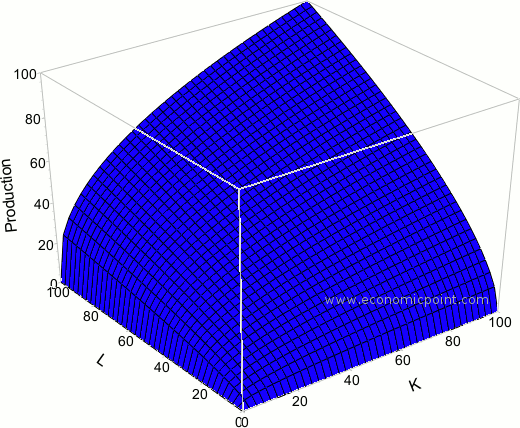
This production function has:
- Positive and decreasing marginal product
- Constant output elasticity
- Easy to measure returns to scale (they are obtained from β+α)
- Easy to go from the algebraic form to the linear form, and that makes this function usefull in econometrics models.
The Leontief Production Function
This function is also called the Fixed Proportion Production Function and represents a production system where factors are used in fixed proportions, for example 1 computer and 1 person.
Matehmatically, this production functions is modelled as:
Q = min (x1/a , x2/b)
Where:
- Q is the quantity of products
- x1: quantity of input 1
- x2: quantity of input 2
- a: unit input requirement of x1
- b: unit input requirement of x2
Constant Elasticiy of Substution (CES) Production Function
The CES Production function is very used in applied research. It shows a constant change in output, produced due to changes in inputs. Matehmatically, the CES function can be represented as follows:
Q = A[aK
β + (1-a) K
β]
1/β
Where:
Q = Quantity of Output
F = Factor Productivity
a = share parameter
K,L = Quantity of Inputs
The elasticity of substitution is s = 1/(1-β)
Production Functions in the Real World
Each type of business or industrial activity, or simply any productive activity (a productive activity is one that combines production factors with the objective of obtaining a result in the form of a good or service) will have a different production function.
Different examples of production functions come to mind. For instance, let us consider a wheat farmer. This businessman will use the land he has, the seeds, labor, fertilizer machinery, irrigation technology, etc. The production function will show our farmer what the production levels are, i.e. the amount of wheat that he will obtain through the combination of all production factors he has at his disposal during that time. This last point, the temporal dimension, is important. By this, we mean to say that the production function makes reference to the moment in time when the technology is unchanging. If there is a technological innovation or a technological step back, in other words if there is a change in the technology, the production function will change.
The Production Function in the short term.
The
short term is the time period during which it is impossible to modify the quantity available of certain factors, called fixed factors. Meanwhile, other factors, called variable factors, can indeed be modified.
It is important to understand that short term and long term do not make lineal reference to a chronological amount of time, but to the concept that short and long term is related to the capacity of the business (production unit) to modify the availability of its factors.
For example, let us assume that our businessman is a neighborhood baker who only tends to this one neighborhood, i.e., he is a small-scale producer (in market size as well as in access to capital). Let us also assume that there is a sudden increase in the demand for bread. The baker in our example can dedicate more of his own time to making bread, causing him to purchase more inputs and eventually, he may need to hire an assistant. In the short term, our baker’s variable factors of the production function are: hours worked and the input variables he uses to make the bread (flour, salt, yeast, water, etc.). It is hard to imagine that this businessman could double the size of his bakery in the short term. Thus, we can see that the capital factors remain fixed in this period of time.
Moreover, we can imagine that our baker’s neighborhood is in a city that has an industrial plant dedicated to making all types of bakery products. The time that this plant needs to respond to the increase in the demand for bread is very different from that of our small business baker. That is to say, this plant can quickly extend the work schedules of current personnel, easily hire more personnel and quickly purchase the quantity of inputs needed for production. As if this were not enough, assuming the industrial bakery’s access to capital is greater than that of the small businessman, the large plant can expand its facility relatively easily.
This example shows how the concepts of short and long term depend on the capacity of each producer to modify all of the factors. To simplify the analysis, it is generally assumed that all production function factors are fixed in the short term, with the exception of labor, which is the only variable factor. Thus, an increase in production is only possible through the addition of labor units.