Currency Boards: How They Work, What They Commit To and What Can Go Wrong
A currency board is more than a promise to keep an exchange rate steady. It commits to converting domestic money at a fixed rate, under rules designed to support that commitment. The arrangement can strengthen confidence, but it also limits how freely monetary policy can respond when the economy is under strain.
Hong Kong’s continuing system and Argentina’s former convertibility regime show both the mechanism and the stakes. Argentina’s currency-board-like regime ended in 2002; it is a historical example, not the arrangement now in force there.
What is a currency board?
A currency board is a monetary system that fixes the value of domestic currency to a chosen foreign currency and commits to convert at that rate. The conversion rule is central: people and financial institutions can exchange currencies under stated terms, and the authorities use the system’s operating rules to support the fixed rate.
That makes a board different from a simple announcement about the nominal exchange rate. The conversion commitment is intended to constrain the monetary authority’s discretion. Hong Kong’s Monetary Authority describes its Linked Exchange Rate System as a currency-board system; the IMF describes Argentina’s former convertibility arrangement as currency-board-like. (HKMA; IMF)
How the exchange-rate mechanism works
Consider a currency board linked to the US dollar. If people and banks want to exchange more domestic currency for dollars, the board supplies dollars and takes in domestic currency. That transaction reduces domestic liquidity. If demand runs the other way, the board buys dollars and issues domestic currency, expanding liquidity. In this way, pressure on the exchange rate can pass through to the money market rather than being absorbed mainly by discretionary intervention.
Interest rates can respond as liquidity tightens or loosens. A currency board does not set every market interest rate directly, but its operating rule can limit the scope to ease monetary conditions independently of the anchor currency. This is part of the commitment: the exchange-rate rule takes priority when it conflicts with other policy objectives.
Hong Kong’s Linked Exchange Rate System began on 17 October 1983. The HKMA states that the Hong Kong dollar is kept within a band of HK$7.75–HK$7.85 per US$1. Under the note-issuance arrangement, the three note-issuing banks obtain Certificates of Indebtedness from the Exchange Fund against US-dollar payment at HK$7.80 per US$1. The note-issuance rate and the wider market band are distinct parts of the system. (HKMA; SEC filing)
For example, if market demand pushes the Hong Kong dollar toward the weak side of its band, banks can exchange Hong Kong dollars for US dollars under the relevant convertibility undertaking. The resulting withdrawal of Hong Kong-dollar liquidity helps put upward pressure on local interest rates and supports the link. This is the balance-sheet mechanism at work, not simply an official declaration of a target rate. (SEC filing; HKMA)
Convertibility and reserve backing
A currency board’s promise depends on the ability to meet conversion demand under its stated rules. Reserve assets and the system’s operating arrangements are therefore important to assessing how the commitment works in practice. A clear, transparent framework can make the exchange-rate promise easier to assess, though no rule can remove all economic or political risks.
The HKMA publishes information on the Linked Exchange Rate System, including its monetary base and interbank liquidity. Those measures help explain how the system operates and how exchange-rate pressure can affect liquidity. (HKMA)
What a currency board gives up
A currency board gives up much of the monetary authority’s ability to set policy for domestic conditions alone. When the anchor currency’s interest rates or monetary conditions do not suit the domestic economy, the board has less room to respond without putting the peg under pressure. It also restricts the ability to create domestic money freely to support the banking system or finance government.
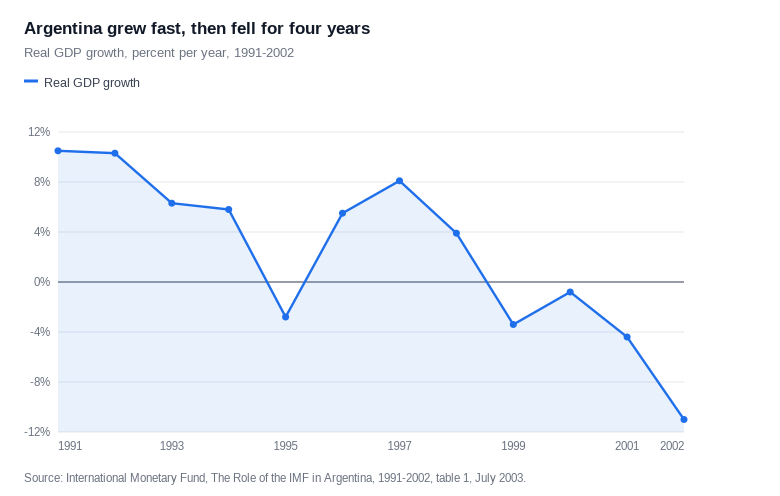
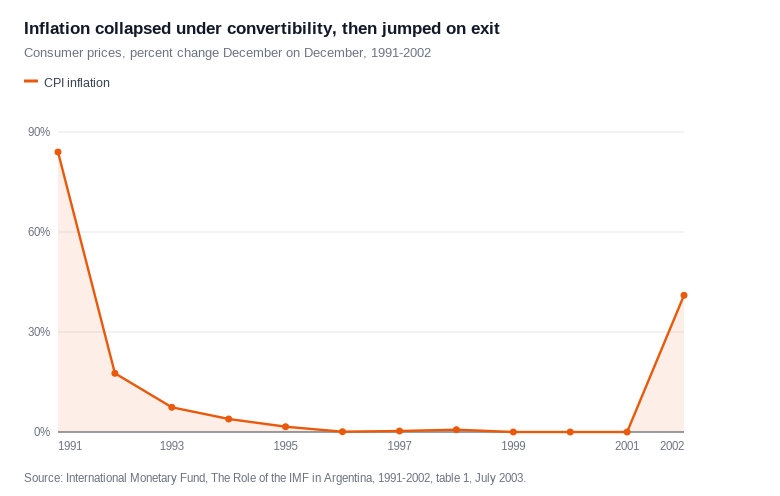
Argentina’s Convertibility Plan illustrates the trade-off. The IMF records that the plan fixed the peso at parity with the US dollar in a currency-board-like arrangement. It brought strong growth and very low inflation for much of the 1990s, but Argentina entered a deep recession in 1998. The IMF’s evaluation notes that the regime constrained the use of standard macroeconomic tools during the downturn. The fixed-rate system was abandoned amid the crisis of December 2001 and January 2002. (IMF)
That history does not establish that a currency board alone caused the crisis. The IMF evaluation also discusses external pressures, debt sustainability, reduced price competitiveness and limited flexibility to adjust. A fixed rate can make adjustment harder when wages and prices do not adapt readily or when trading partners’ currencies move sharply. Changes in the real exchange rate can therefore matter even when the nominal link holds.
Argentina’s 1991 currency-board-like convertibility system ended in 2002. It should be treated as a historical example, not as a description of the country’s current monetary arrangement. (IMF)
Currency board versus a conventional peg
Both arrangements aim to keep an exchange rate near a chosen level. The difference is the strength and design of the commitment. A conventional peg can be maintained through intervention and interest-rate policy while leaving the monetary authority more discretion over how to respond. A currency board makes convertibility central to its operating rules, narrowing that discretion.
The distinction is not merely about whether a rate is fixed. It is about what the authorities are committed to do when demand for currencies shifts—and what policy options remain available if defending the rate conflicts with domestic goals.
How to assess a currency board
Start with the rule: What can be converted, at what rate, and by whom? Then examine how the system operates, what information is published about its reserves and liquidity, and whether the commitment is clear enough for market participants to assess.
Next, consider how the economy might adjust if domestic conditions diverge from those in the anchor-currency economy. Relevant questions include whether prices and wages can respond, how exposed the economy is to external shocks, and whether public finances and financial institutions can withstand tighter conditions. A currency board can make the exchange-rate commitment more credible; it cannot guarantee that the wider economy will adjust smoothly.
Hong Kong’s system and Argentina’s former convertibility regime should not be treated as interchangeable examples. Hong Kong’s Linked Exchange Rate System remains in operation, while Argentina’s former arrangement ended in 2002. Their different experiences underline the importance of the rules, the economy’s capacity to adjust and the conditions under which the commitment is maintained.
Bottom line
A currency board trades monetary flexibility for a rule-based exchange-rate commitment. Its effects depend both on how conversion works and on whether the economy can adjust when domestic conditions diverge from those in the anchor-currency economy.
Sources and further reading
- Hong Kong Monetary Authority, Linked Exchange Rate System.
- International Monetary Fund, The Role of the IMF in Argentina, 1991–2002.
- U.S. Securities and Exchange Commission, PCCW annual filing.
- U.S. Securities and Exchange Commission, PCCW annual filing.