Why Do Central Banks Target 2% Inflation?
Central banks do not target 2% inflation because prices rising by exactly that amount is a natural economic law. It is a practical choice: modest positive inflation can provide room to respond to downturns, make some price and wage adjustments easier, and give households and businesses a reference point for expectations. Each benefit comes with costs, so 2% is a compromise—not a guarantee of stable prices or a forecast of what inflation will be.
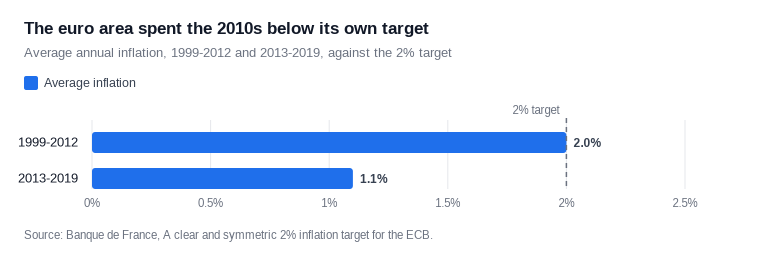
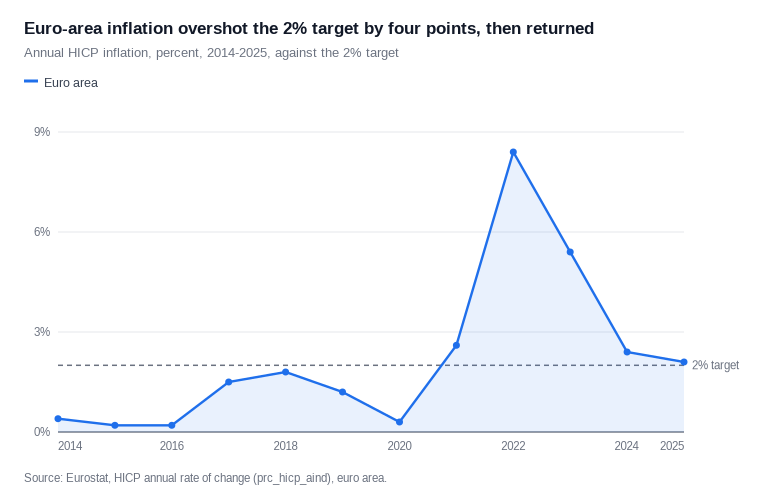
A target is not a forecast or a monthly limit. It is the rate a central bank aims for over a stated period, measured using a specified price index. The Federal Reserve’s longer-run goal is 2% annual inflation measured by the personal consumption expenditures price index (PCE). The European Central Bank (ECB) aims for 2% inflation over the medium term, measured by the euro-area Harmonised Index of Consumer Prices (HICP). (Federal Reserve; ECB)
Why not target zero?
A zero target would leave no cushion against deflation—an overall fall in prices. Deflation can make monetary policy harder: when interest rates are already very low, a central bank has less room to cut them to support demand. A positive inflation buffer reduces the risk of facing that constraint. The ECB cites both a safety margin against deflation and the limits on interest-rate policy near its effective lower bound as considerations for its target. (Banque de France)
The lower bound does not eliminate all possible action. Central banks can also use tools such as asset purchases and forward guidance. But being near the lower bound still limits what they can achieve through conventional interest-rate policy alone. (Bank of Finland)
Why not a higher target?
A higher target would generally give a central bank more room to cut interest rates before reaching the lower bound. But inflation also has costs. More frequent price increases can require businesses to spend time and resources changing prices, and higher inflation can be associated with greater inflation volatility. Choosing a target means balancing the room to respond to downturns against the costs of a less stable price environment. There is no exact calculation that makes 2% a universal optimum. (Banque de France)
The case for a modest buffer
Not every price can adjust smoothly. If wages are slow to fall in money terms, a business facing weak demand may find it difficult to reduce labour costs through outright wage cuts. With modest overall inflation, wages that rise more slowly than prices can still fall in real terms. A positive target can also help accommodate changes in relative prices: one product or service can become cheaper relative to others even if its own price does not fall. These are among the reasons for keeping a positive buffer. (Banque de France)
That buffer depends on the target being credible. A clear target gives workers, firms and investors a shared reference point when making decisions about wages, prices and contracts. The ECB’s symmetric target is intended to anchor inflation expectations. Symmetry means that inflation below the target is treated as a deviation too, rather than implying that only inflation above it matters. (ECB)
What the targets actually say
Central banks can share a 2% figure while differing in the index they use and the period over which they aim to reach it. The Federal Reserve’s longer-run goal is 2% annual inflation measured by the PCE price index. The ECB’s target is symmetric 2% inflation over the medium term, measured by HICP. Neither target promises that inflation will equal 2% every month or every year. A medium-term horizon allows policy to respond to shocks without treating every short-lived deviation as a reason for an immediate correction. (Federal Reserve; ECB)
These examples also show why a headline target alone is not enough to describe monetary policy. The index, time horizon and approach to deviations all affect how the target works in practice. Inflation is one of many economic variables central banks consider: the target guides policy, but does not mechanically determine every decision.
The central idea is straightforward: 2% aims to keep inflation positive enough to provide a cushion, but low enough to limit the costs of rising prices. The exact number remains a policy choice shaped by a central bank’s mandate and framework—not a universal rule for every economy.
Sources and further reading
- Federal Reserve: Statement on Longer-Run Goals
- European Central Bank: Monetary policy strategy
- Bank of Finland: ECB renews its monetary policy strategy
- Banque de France: A clear and symmetric 2% inflation target for the ECB